How Mobile Maintenance Management Improves Response Times
If you have worked in a hotel during a peak weekend and witnessed an insignificant repair escalate to a guest’s complaint and subsequently lead to a bad review, then you probably know what this blog post talks about. The gap between a maintenance issue being discovered and that issue being resolved is where guest satisfaction is won or lost in real time. For most hotels in the USA still running on manual coordination, that gap is far wider than it needs to be — and the reason almost always comes down to the same thing: communication that’s too slow, too fragmented, and too dependent on people being in the right place at the right time. Mobile maintenance management software changes this dynamic completely — and this blog explains exactly how, why it matters for response times specifically, and what the difference looks like in a real hotel environment.
The Response Time Problem That Most Hotels Underestimate
Let’s start with an honest look at what actually happens when a maintenance issue is discovered in a traditionally operated hotel.
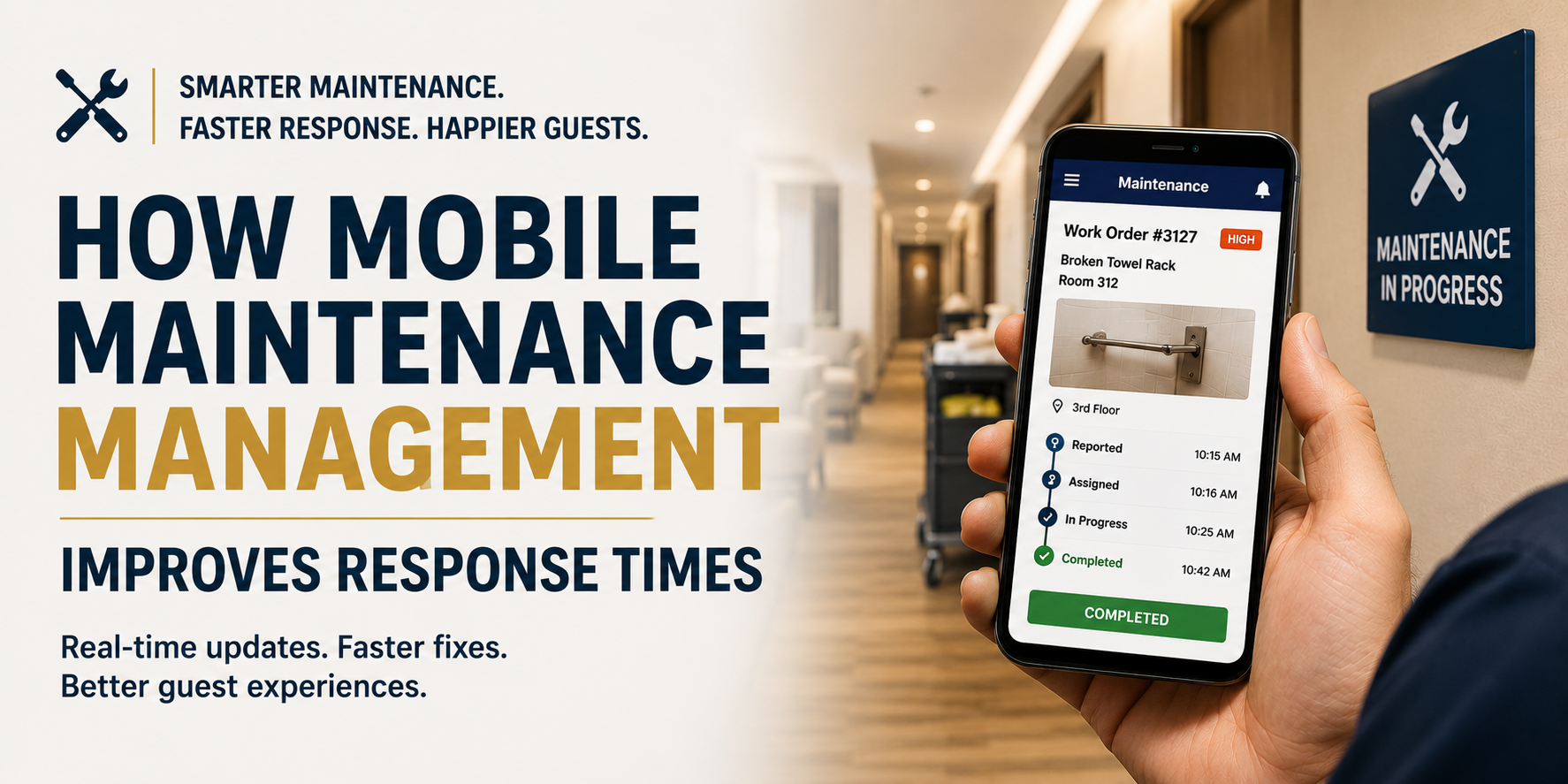
A housekeeper finds a broken towel rail in Room 312 during a turnover. She finishes the room, goes back to the housekeeping station, and tells the supervisor. The supervisor writes it down — or remembers it and at some point radios the maintenance team. The maintenance team lead receives the message, adds it to a mental list of things to address, and gets there when they get there. Nobody knows whether it’s been fixed until someone physically checks. The front desk, meanwhile, has no idea any of this happened.
This chain of events, from discovery to resolution — typically takes anywhere from a few hours to multiple days in hotels without a structured digital system. During that time, Room 312 might be assigned to an incoming guest. The front desk might apologise for a problem they didn’t know existed. The guest might write a review mentioning the broken fitting. And the maintenance team might be blamed for slowness when the real failure was the communication system, not the people.
Mobile maintenance management exists specifically to break this chain — replacing it with a connected, real-time workflow that moves faster at every step.
What Mobile Maintenance Management Actually Means
The term gets used loosely, so it’s worth being specific about what it actually describes.
Mobile maintenance management means that every step of the maintenance workflow — discovery, logging, assignment, tracking, resolution, and reporting — happens on mobile devices that staff carry with them throughout the property, rather than through desktop systems, paper logs, radio calls, or verbal handoffs.
When a housekeeper discovers an issue in mobile hotel operations software, she logs it immediately on her phone. She includes a brief description, tags the location, optionally attaches a photo, and marks the priority level. The system instantly notifies the right maintenance technician. The technician sees the alert on their mobile device, acknowledges it, proceeds to the location, resolves the issue, and marks it complete — all from their phone, all with timestamps, all visible to every relevant person in real time.
From detection to resolution, the whole process is done without any radio communication, telephone call, written message, or journey to a supervisor's office. The communication problem, which used to take hours, is shortened to mere minutes.
How Response Times Actually Improve - The Specific Mechanisms
Understanding why this improves response times requires looking at where the time goes in traditional systems. It’s not usually the repair itself that takes long. It’s everything surrounding it.
Notification delay - In manual systems, issues are communicated through people rather than through systems. Each handoff adds time. A digital notification sent instantly when an issue is logged eliminates this delay.
Priority confusion - Without a clear system, maintenance teams address issues based on who shouted loudest or which supervisor they spoke to last. Hotel maintenance management software that allows issues to be tagged by priority ensures that the most urgent items are visible and actioned first, not whoever happened to call most recently.
Location tracking - In a mobile system, maintenance technicians can be assigned to the nearest relevant task based on their current location within the property. Rather than a technician finishing a job on Floor 3 and returning to the maintenance office before being redirected to Floor 5, the next assignment reaches them where they are.
Status visibility - When supervisors can see in real time which issues are open, in progress, and resolved on a dashboard rather than waiting for verbal updates, their ability to manage workload and escalate appropriately is dramatically better.
Automatic escalation - Issues that haven’t been acknowledged or resolved within a defined time window can trigger automatic alerts to supervisors, ensuring that nothing sits in a queue indefinitely without someone being aware.
Each of these systems lowers response time individually. In combination, they account for the rapid improvement in response times that hotels invariably note when switching to a mobile-connected system.
Hotel Preventive Maintenance Software - The Proactive Layer
Improving response time to reactive maintenance requests is valuable. But the most operationally mature hotels take it further — using mobile maintenance systems to shift from reactive to proactive maintenance entirely.
Hotel preventive maintenance software manages scheduled inspections and equipment checks on a defined calendar. When a scheduled maintenance task is due — a fire safety check, a pool chemical test, a generator inspection, an HVAC filter replacement — the system creates the task automatically. It assigns it to the relevant team member, who receives it on their mobile device.
The technician finishes the inspection and logs the results as “complete,” along with a timestamp, log note, and the problem found, if there was one, in the inspection. A flagged problem from a scheduled inspection goes straight into the reactive maintenance procedure as another logged issue.
This proactive approach addresses one of the most significant cost drivers in hotel maintenance, equipment failures that were entirely predictable but weren’t caught because scheduled inspections weren’t being tracked systematically. A CO detector that was never checked. A generator that failed during a power outage because its last test wasn’t logged. A pool that went out of chemical balance because the weekly check didn’t happen consistently.
Real-time maintenance tracking of both scheduled and reactive tasks gives hotel operations managers a complete, accurate picture of maintenance health across the property — not a partial picture based on what someone remembered to report.
What Response Time Improvement Looks Like in Real Numbers
The effect that mobile maintenance management has on response times is not theoretical; it is quantifiable and constant among hotels that make the switch.
Hotels moving from manual to digital maintenance coordination typically report:
Reactive maintenance response time is dropping from an average of several hours to under 30 minutes for standard issues. Guest-impacting maintenance items — broken locks, HVAC failures, plumbing issues — are being resolved before the next guest check-in rather than being discovered at check-in. Preventive maintenance completion rates are increasing from inconsistent (because nobody was tracking) to above 90% (because every scheduled task has an assigned owner and a visible status).
These aren’t aspirational numbers — they’re what connected mobile systems produce when deployed properly in a real hotel environment. The technology doesn’t change the skill of the maintenance team. It changes the information environment they operate in, and better information consistently produces faster outcomes.
The Guest Experience Connection
Maintenance response time is not an internal hotel metric. It is a direct driver of guest experience — and the connection is more direct than most general managers account for in their operational planning.
A guest who reports a problem and receives a resolution within 20 minutes has an experience that often generates a positive review — the hotel took care of me quickly. A guest who reports a problem and waits three hours has an experience that generates a negative review — the hotel didn’t seem to care. The physical problem in both cases might be identical. The service response is what determines the outcome.
When you multiply this impact over the number of guests interacting with a hotel each month, it can amount to a huge difference. Hotels that respond quickly and efficiently with maintenance get an edge over others in all service-related review metrics, which in turn influences future bookings for other potential guests.
The investment in mobile maintenance management is not just an operational cost. It is a revenue protection mechanism.
How InnCrew Solves the Maintenance Response Problem
InnCrew’s maintenance management feature is built around exactly this challenge — eliminating the communication delays that slow maintenance response in traditionally operated hotels.
With InnCrew, maintenance issues are logged instantly by any team member from a mobile device, assigned immediately to the relevant technician with automatic alerts, tracked through the entire workflow from open to in-progress to resolved, visible in real time to supervisors and management on a live dashboard, and stored with complete records — who logged it, who fixed it, when, and how long it took.
The system handles both reactive issues logged by staff and scheduled preventive maintenance tasks managed on a calendar — giving operations teams a single, connected view of all maintenance activity across the property.
That visibility — everything visible, instantly, on mobile, is the operational reality that InnCrew delivers for hotel maintenance teams across the USA.
FAQ
Q1. What is mobile maintenance management software for hotels?
It helps hotel teams track, assign, and resolve maintenance issues from mobile devices in real time.
Q2. How does mobile maintenance software improve hotel response times?
It sends instant alerts, speeds up task assignment, and reduces communication delays.
Q3. What is the difference between reactive and preventive hotel maintenance?
Reactive maintenance fixes problems after they occur, while preventive maintenance helps prevent issues before they happen.
Q4. How does real-time maintenance tracking help hotel operations?
It gives managers live visibility into maintenance tasks, helping teams respond faster and stay organized.
Q5. Can mobile maintenance software handle preventive maintenance scheduling?
Yes. It can automatically schedule inspections, assign tasks, and track completion records.
Q6. Is hotel maintenance software suitable for small hotels?
Yes. Many cloud-based solutions are affordable and work well for independent and small hotels.
Q7. How do I know if my hotel needs maintenance management software?
If maintenance requests are delayed, difficult to track, or causing guest complaints, maintenance software can help.
Q8. What is the best mobile maintenance management software for hotels in the USA?
Look for a mobile-first platform with real-time tracking, preventive maintenance tools, and easy staff communication. InnCrew is one option designed specifically for hotel operations.