Manual vs Automated Hotel Operations: What’s Slowing Your Team Down?
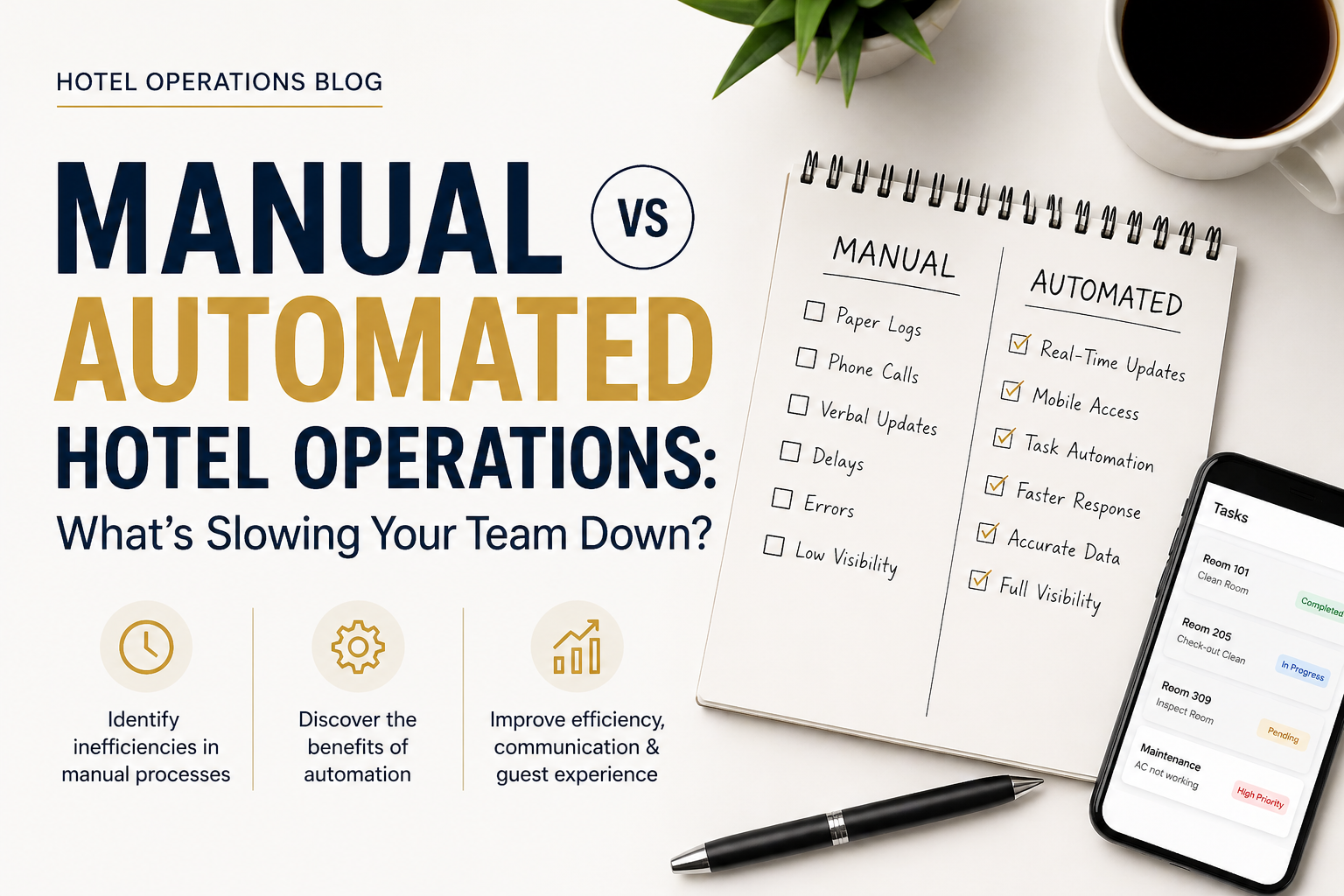
Running a hotel looks glamorous from the outside: happy guests, beautiful lobbies, seamless service. But behind the scenes, most hotel teams are fighting a completely different reality — one built on walkie-talkies, paper checklists, verbal handoffs, and outdated processes that eat up hours every single day. If your team is constantly playing catch-up, if guests are waiting longer than they should, or if your front desk and housekeeping teams feel like they’re working in different worlds, the culprit is almost always the same thing. The gap between manual hotel operations and what hotel automation software can actually deliver in 2026 has never been wider. And the hotels that haven’t crossed that gap yet are feeling it in their reviews, their revenue, and their staff retention.
By adopting automation, hotel teams can feel more confident and valued as speed and accuracy improve, reducing manual errors and frustration.
The Manual Hotel Operations Problem - Let’s Be Honest About It
Transitioning to automation is straightforward, offering hotel owners reassurance and confidence as they embrace a smarter approach.
And then there’s the honest version — which is what actually happens in hotels that are still running on manual systems every single day.
A guest calls the front desk to report a maintenance issue. The front desk writes it down, calls the maintenance supervisor on a radio or phone, the supervisor relays it to the available technician, the technician goes to the room, fixes the issue, and then reports back verbally. At some point maybe, this gets logged somewhere. The guest, meanwhile, has been waiting 45 minutes and wondering whether anyone actually knows about their problem.
Multiply that single scenario across an entire property, every department, every shift, every day. That’s what manual hotel operations problems look like at scale. Not one missed note — a thousand small breakdowns that compound into a significant drag on every operational metric that matters.
Where Exactly Does Manual Operations Lose Time?
Let’s break this down by department, because the inefficiencies are not abstract they’re specific, repeatable, and entirely fixable.
Housekeeping
Manual housekeeping coordination typically involves a printed room assignment sheet distributed at the start of a shift. When a guest checks out early, or a late check-in request comes through, or a room priority changes — that sheet is already wrong. Supervisors spend significant time chasing updates over the phone, reassigning staff verbally, and trying to maintain an accurate picture of room status in real time.
The result: rooms that aren’t turned over in time, guests who wait at the front desk, and housekeeping teams that spend as much time communicating about work as they do actually doing it.
Maintenance
In a manually operated hotel, maintenance requests exist in several places simultaneously — a paper log at the front desk, a verbal handoff to the supervisor, a note on a whiteboard, and a memory in someone’s head. None of these sources is reliable as a single source of truth. Requests get missed. Priorities get confused. Follow-up doesn’t happen because nobody is sure whether the issue was actually resolved.
Preventive maintenance — the inspections and scheduled checks that keep a property in good condition — is even harder to manage manually. Checklists get skipped. Intervals slip. Equipment fails because the scheduled maintenance that should have caught the problem was delayed or forgotten.
Front Desk and Guest Services
The front desk acts as the heart of a hotel’s operations. Information from all departments flows into it, and it is responsible for the guest experience during their stay. Without an automated system, the front desk staff have no option but to receive constant verbal updates and make calls to obtain information they don’t have.
This creates a situation in which front desk staff is simultaneously the most important customer-facing team in the hotel and among the most operationally burdened. The time they spend managing information gaps is time they’re not spending on the guests standing in front of them.
Staff Communication and Shift Handovers
Manual shift handovers are a particular source of operational loss. A supervisor ends their shift and spends twenty minutes verbally briefing their replacement, covering the status of open tasks, pending requests, and any issues that need monitoring. The incoming supervisor makes notes or doesn’t, and starts their shift with an incomplete picture of what’s actually going on.
An organization does not have a process of maintaining an active log for any system; thus, organizational knowledge goes out the door as soon as a shift changes. The new crew does everything from scratch.
What Automated Hotel Operations Actually Change
The difference between manual and automated hotel operations is not just about speed — though speed is part of it. It’s about accuracy, accountability, and the ability to make decisions based on real information rather than best guesses.
Real-Time Task Visibility
In a setting where automation is in place, when a client initiates a service request at the front desk, the system will instantly record it, prioritize it, assign it, and make it viewable to all relevant parties simultaneously. The technician receives the service request on their mobile terminal, updates its progress until completion, and marks the service as completed once it is finished. The front desk sees the updated status without initiating any calls. This increases efficiency for both the guest and the supervisor.
This is how workflow automation works at a hotel – not through some advanced technological restructuring, but through a seamless transfer of information, replacing oral communication and documentation with digital information.
Smarter Housekeeping Coordination
Automated housekeeping management allows room status to be updated in real time from a mobile device. When a room is cleaned and ready, the housekeeping team member marks it immediately. The front desk sees the update instantly. Room assignment changes can be pushed directly to the relevant staff member, eliminating the need for a supervisor to track down the right person and relay the information verbally.
The result is faster room turnovers, more accurate room status, and a housekeeping team that spends more time cleaning rooms and less time waiting for instructions or chasing updates.
Preventive Maintenance on Schedule
Automated maintenance management allows inspection schedules, equipment checks, and compliance requirements to be set up in advance and triggered automatically when they’re due. Staff receive alerts on their mobile devices. Completed inspections are logged with timestamps. Overdue items are flagged for supervisor attention.
Nothing falls through the cracks because the system maintains the schedule and accountability—not a person trying to track multiple responsibilities simultaneously.
Accountability Without Micromanagement
One of the most significant benefits of hotel task management software is that it creates accountability without requiring constant supervision. When every task is logged, timestamped, and assigned to a specific team member, managers have an accurate picture of what was done, who did it, and when — without having to monitor every area of the property in person.
That is a significant shift in terms of how management works. The managers will be able to spend time on mentoring, quality assurance, and handling exceptions without wasting time collecting status reports or chasing tasks that might already be done.
The Staff Experience Matters Too
Discussions on hotel operational efficiency usually revolve around guest satisfaction and profit indicators, which are indeed very significant. However, the effect of the manual system on hotel employees should also be considered.
Working in a poorly organized manual system is truly tiring. Inability to trust the information provided, lack of knowledge regarding tasks completed and those left unattended, the same issues arising during each shift – this is how employee burnout and high turnover rate occur.
The hospitality industry in the USA already faces significant staff retention challenges. Hotels that give their teams clear, reliable tools — that reduce frustration, remove ambiguity, and let people focus on doing good work — see measurable differences in staff satisfaction and retention. The investment in hotel staff productivity tools pays back in reduced turnover costs, faster onboarding, and a team that genuinely enjoys working in a well-run environment.
This is not a small consideration. The cost of replacing a trained hospitality employee — recruiting, onboarding, and the productivity gap while they’re getting up to speed — is significant. Anything that keeps good people on your team longer has direct financial value.
Why Cloud-Based Systems Are Non-Negotiable in 2026
A few years ago, cloud-based hotel management was a differentiator — something forward-thinking properties were adopting ahead of the curve. In 2026, it’s a baseline requirement for any hotel that wants to operate efficiently.
The reason for adopting this strategy is simple: the complexity of the activities involved in managing a hotel has become too much to handle with a local system and manual processes. There are variations in requirements. The employees work in several locations in the same hotel. Management needs to oversee operations in real time.
Cloud-based hotel operations software solves these challenges by making operational data available to every authorized user, in real time, from any device — whether they’re at the front desk, in a guest room, or managing the property remotely. Updates happen instantly. Information is always current. The operational picture is accurate rather than estimated.
For a multi-property hotel, centrally centralized cloud access transforms what’s possible from a management perspective. A regional manager can see the real-time operational status of every property in their portfolio without making a single phone call.
The Transition From Manual to Automated - How It Actually Works
One of the most common hesitations hotels have about moving away from manual systems is the fear of disruption. “We’re a busy property — we can’t afford a complicated implementation.”
The good news is that modern hotel operations management software is designed specifically for busy hotel teams. The best systems are mobile-first — meaning staff use them on the devices they already carry rather than needing to learn a new hardware system. Implementation is typically fast, training requirements are minimal, and the system is designed to complement existing processes rather than requiring a complete operational overhaul.
The transition generally goes smoothly, with current processes outlined, configured in the software, and people trained minimally, so they can start deriving benefits immediately. Hotels that transition to this new system usually show significant improvements in guest turnaround time, customer service ratings, and staff coordination within just a few weeks.
What Hotels That Have Made the Switch Are Saying
The comments shared by the hotel staff, who have shifted from manual to automated systems, speak the same language. The managers state that they finally have an operational perspective. The front desk team says they feel at ease not having to run all over the hotel to find information. The housekeeping supervisor feels delighted with the flexibility to manage the room assignment process.
Maintenance crews emphasize how much of a difference it makes to be able to get instant notifications along with logs of all inspections performed - not only in terms of day-to-day maintenance but also from a standpoint of compliance with regulations, insurance, and quality audits. Hotel managers say they can know exactly what is going on in their building.
The pattern across all of these accounts is the same: the manual system felt normal until they saw what was possible. After the transition, going back to the old way is unthinkable.
The Real Cost of Staying Manual
Here’s the calculation that most hotel operators haven’t done explicitly, but would find clarifying if they did.
Take the time your supervisors spend each day chasing status updates, handling miscommunications, and manually logging information that a system would capture automatically. Multiply that by your team size. Multiply by 365. Then add the cost of guest complaints that stem from operational delays, the revenue lost from rooms that aren’t turned over on time, and the staff turnover driven by a frustrating work environment.
The total cost of staying manual is significant and almost entirely invisible because it’s embedded in the daily operations that feel normal. The cost of hotel management automation software is visible on an invoice. The cost of not having it is spread invisibly across every inefficient hour your team works.
Final Thought
The gap in efficiency between hotels that still operate on traditional systems and those that rely on modern automation tools keeps widening year over year. Those hotels that switched early have become increasingly efficient and productive, gaining an edge over competitors.
For USA-based hotels still running on manual coordination, the question isn’t whether to make the change, it’s how quickly you can do it without disrupting your current operations.
If you’re looking for a starting point, InnCrew is a mobile-first hotel property management system built specifically for hotel teams who want to move faster, coordinate better, and finally get a real-time picture of everything happening across their property from housekeeping and maintenance to inventory and guest services.
FAQs
Q1. What is hotel automation software?
It helps hotels manage housekeeping, maintenance, staff tasks, and communication in real time through one digital system.
Q2. What are the biggest problems with manual hotel operations?
Manual operations cause delays, missed tasks, poor communication, and slower guest service.
Q3. How does hotel automation improve guest satisfaction?
It speeds up responses, improves coordination, and helps staff resolve guest requests faster.
Q4. Is hotel management software suitable for small hotels?
Yes. Many modern systems are affordable and built for independent and boutique hotels.
Q5. What is the difference between a PMS and hotel operations software?
A PMS handles reservations and billing, while operations software manages housekeeping, maintenance, and staff tasks.
Q6. How long does it take to implement hotel automation software?
Most mobile-first systems can be set up quickly with minimal staff training.
Q7. Can hotel staff use automation software on mobile phones?
Yes. Staff can manage tasks, update room status, and communicate directly from their phones.