How Real-Time Inventory Tracking Improves Hotel Operations
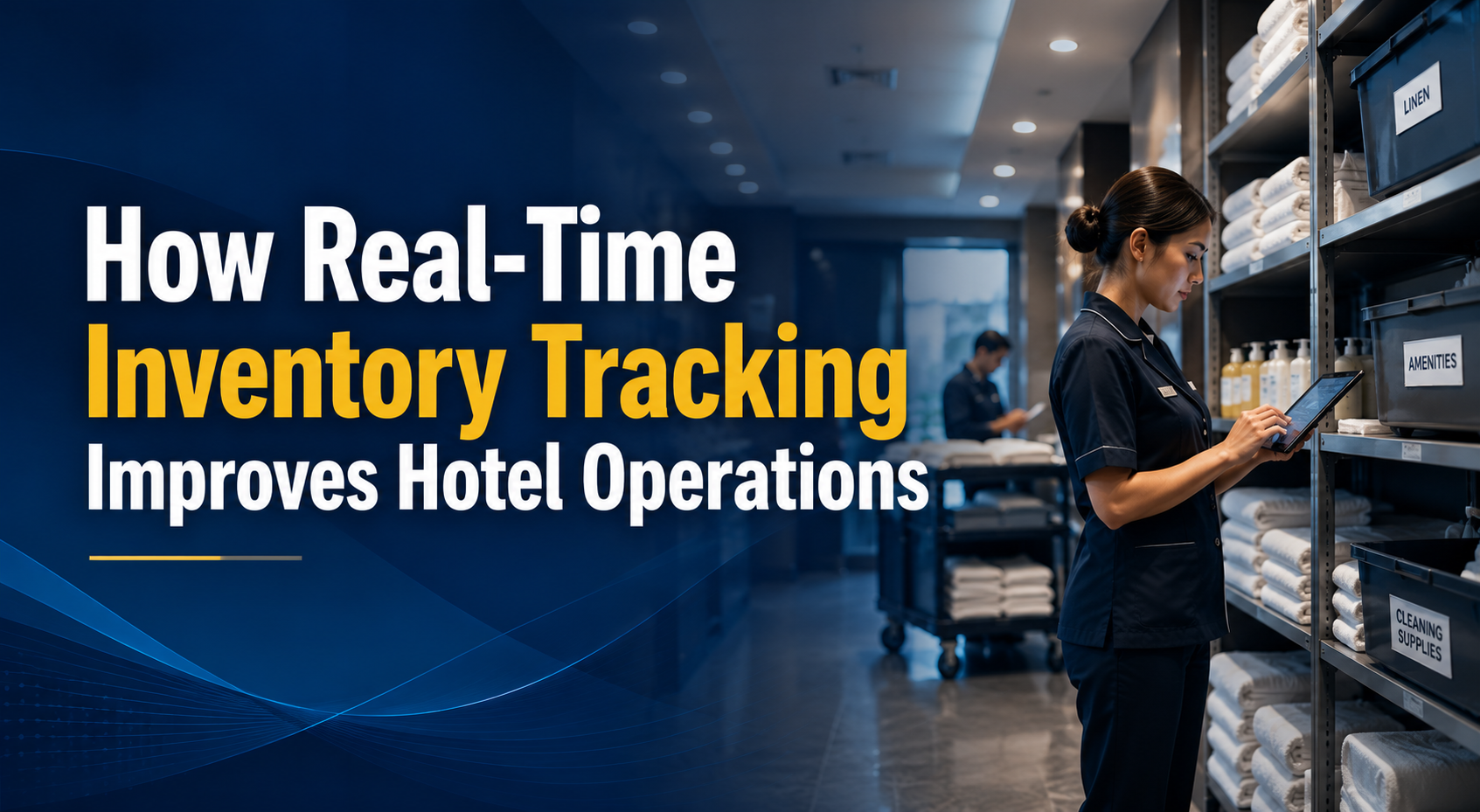
Most hotel managers think about inventory as a housekeeping concern: toiletries, towels, linen, cleaning supplies. The kind of thing someone checks on occasionally and restocks when things run low. However, if you have experienced delays in your housekeeping services due to the amenities cart running out of items, or delays in your maintenance requests because of the unavailability of parts, or the 11 pm discovery that the breakfast team is short of an essential item for the next day, then you already realize that hotel inventory management goes beyond just a list of supplies. Inventory deficiencies not only cause supply shortages but also cause delays, guest dissatisfaction, staff disruption, and emergency procurement costs that are always higher than the cost of the supplies themselves if there was adequate planning. This blog explains what real-time inventory tracking actually changes in a hotel operation and why the hotels managing it best are doing something fundamentally different from the ones still running on periodic manual counts and instinct.
Why Traditional Inventory Management Falls Short in Hotels
The traditional method of managing hotel inventories follows a predictable process. A person conducts an inventory count on a weekly, fortnightly, or monthly basis depending on the hotel. He determines what items are in short supply. He orders more of such items. The process starts all over again.
This process has an inherent flaw: the time period from when a shortage occurs until the time it is found out. If the stock becomes depleted on a Tuesday and the next check is due on a Friday, then there are three days in which disruption can take place before the situation is recognized. Over these three days, the housekeepers may be functioning with inadequate supplies, the maintenance may not be able to fix anything because the required stock has not been found yet, and the guests’ stay has been affected without their even knowing it.
Another disadvantage of periodic counting is that while it gives you an idea of inventory in a given period, it does not give you any information about the consumption patterns in the same period. You know for a fact that there are 200 units of a particular amenity currently in stock, but there is no way for you to figure out whether the 200 units will last till your next delivery order depending on the trends of occupancy.
Hotel inventory management software that tracks in real time addresses both of these gaps, the awareness gap and the forecasting gap simultaneously.
What Real-Time Inventory Tracking Actually Means
The term real-time gets used loosely in hotel technology, so it’s worth being specific about what genuine real-time inventory tracking looks like in practice.
As opposed to updating stocks at the end of the work shift or conducting a weekly stock count, in a real-time inventory system, inventory is tracked when they are used. Every time the housekeeper accesses linen from the linen closet, the change is accounted for within the inventory system. Whenever a technician accesses a replacement part from the store of supplies, the use is registered. Amenities added to the housekeeping cart to be taken to the rooms allocated are also tracked within the inventory system.
The practical result is a live inventory picture that reflects actual current stock rather than an estimate derived from the last count. Managers can see, at any moment, what is actually on hand across every storage point in the property, not what was on hand last week with some rough mental calculation about what has been used since.
For hotels with multiple departments drawing from multiple storage points, this live visibility is particularly valuable. Housekeeping, maintenance, food and beverage, and the front desk may all be drawing from various supply categories simultaneously. Without a connected tracking system, the only way to know total consumption across all departments is to visit every storage point physically — something that is neither practical nor frequent enough to prevent shortages from developing unnoticed.
How Real-Time Tracking Prevents Operational Disruptions
The specific operational disruptions that hotel inventory management failures cause are worth naming clearly, because they add up to more than most managers fully account for.
The housekeeper who finds out in the middle of her shift that she has run out of toiletries faces more than just a trivial problem. She has to break off her cleaning schedule, go back to the housekeeping station, notify her supervisor, wait for somebody to find out if there are enough toiletries left somewhere or if they are indeed not in stock, and then continue with whatever is available or an altered cleaning schedule. She loses at least 15-30 minutes of her cleaning time due to this.
A maintenance technician who arrives at a room with a specific repair requirement, finds the needed part or supply is not in stock, and has to wait for an emergency procurement or workaround is a disruption that delays the room’s availability and creates a guest experience problem if the room was expected to be ready.
A food and beverage team that discovers a supply gap the morning of a full breakfast service is in crisis management mode during exactly the period that requires the most operational calm.
In every case, the disruption is not caused by a supply shortage in isolation — it’s caused by a supply shortage that wasn’t known about in advance. Real-time hotel Reporting management converts these reactive crises into proactive management by surfacing the shortage before it reaches the point of operational impact.
The Automated Alert Advantage
One of the most practically valuable features of connected hotel inventory management system software is automated low-stock alerts, notifications that trigger when any inventory category drops below a predefined threshold.
The threshold for each item should be set based on consumption rate and lead time. If a particular amenity is consumed at roughly 50 units per day and the lead time for reordering is two days, the alert threshold might be set at 120 units — enough to cover two days plus a buffer. When stock drops to that level, the relevant manager receives an alert and can place the order without interrupting the operation.
This approach transforms the process of inventory management into an event-driven activity, where one is not expected to pay particular attention to it all the time but to become aware of its necessity when action is necessary. It is not the responsibility of the manager, who will have to set thresholds to constantly remind himself about the stock levels; the system will do this for him.
For hotels managing a large number of SKUs across multiple departments, this shift from active monitoring to alert-driven response is a significant reduction in management overhead — while simultaneously improving the reliability of supply availability.
How Real-Time Inventory Data Improves Procurement Decisions
Apart from avoiding shortages in the short term, the hotel inventory system linked to real-time consumption information will definitely improve the quality of the procurement decision-making process.
Now that you are able to understand how many units of each product are being used daily, weekly, and depending on occupancy, the decision regarding procurement is no longer made by guesswork but is made from a factual perspective. You now have the information that a certain type of amenity category is being used at an average of 1.3 units per occupied room. You know that usage goes up when there is peak occupancy over the weekend, and usage decreases on other mid-week days.
This data-driven approach to procurement reduces both of the most common inventory management failures: running out before the next delivery because par stock was set too low, and accumulating excess stock of items that are consumed more slowly than assumed, tying up budget in supplies that are sitting in a store room.
Hotel inventory software that provides consumption reporting alongside real-time stock levels gives procurement managers the information needed to set appropriate par levels, optimise order frequencies, and reduce both shortage risk and excess stock simultaneously.
Inventory Management Across Multiple Storage Points
Most hotels don’t manage inventory from a single central location. Housekeeping supplies may be distributed across multiple floor-level linen rooms. Maintenance parts may be stored in a central maintenance room and in a secondary location for the other wing or floor. Amenities may be held in a central supply room and dispensed to housekeeping carts at the start of each shift.
Managing inventory across multiple storage points is significantly more complex than managing a single central store, and it’s where manual counting methods are most likely to produce inaccurate pictures of actual availability.
Integrated hotel operations management systems with inventory tracking are capable of keeping track of inventory levels in all storage locations at the same time. In case there is movement of stock from the main store to the floor linen store, the system captures this draw from the main store and addition to the floor location. The draw by the housekeeper from the floor location is recorded as well.
This multi-location visibility is what allows a manager to see not just total inventory but where within the property inventory is distributed — identifying situations where one location is overstocked while another is running low and stock can be redistributed rather than ordering additional supplies.
The Connection Between Inventory Management and Staff Productivity
There is a direct connection between inventory management reliability and housekeeping staff productivity, and it runs in both directions.
When there is a ready availability of supplies at the point where they are required, then the housekeeper works on their duties without any hindrance. The cleaning process goes on without any problem, room turnaround times are always consistent, and the housekeeper completes their shifts in an orderly manner.
The lack of dependable supplies negatively impacts housekeeping productivity in ways that cannot be seen on a day-to-day basis but can be felt in their impact. Housekeeping staff members accustomed to dealing with the lack of supplies will use various tricks, like splitting amenity kits, using substitutions, and leaving out steps of restocking that negatively impact the room condition and give guests an inconsistent experience. The management’s attention is diverted from quality management and the development of staff members to solving supply issues. The department works inefficiently, and this is not due to poor performance but to poor systems.
Reliable inventory management is, in this sense, a staffing productivity investment as much as a supply management one. It removes a category of operational friction that consistently reduces the effectiveness of otherwise capable housekeeping teams.
How Inventory Tracking Supports Compliance and Audit Requirements
For hotels that operate under specific regulatory requirements — food safety standards for properties with catering operations, health and safety requirements for cleaning chemical management, or brand compliance standards for franchised properties inventory tracking provides an important documentation layer that manual counting cannot produce with the same reliability or detail.
A digital inventory system maintains timestamped records of stock receipts, consumption, and stock levels at defined intervals. This will give an audit trail, showing proof of adherence to storage and usage policies without needing to document it manually. In the case that a health inspection, brand audit, or insurance assessment needs proof of how products have been stored and used, the proof is in the system and not in manually kept records that could be inaccurate.
InnCrew - Real-Time Inventory Tracking as Part of a Connected Operations Platform
InnCrew is a hotel operations companion tool that includes real-time inventory tracking as part of a complete hotel operations platform — alongside housekeeping coordination, maintenance management, task tracking, and operational reporting.
The inventory management capability in InnCrew reflects the same mobile-first, real-time design philosophy that applies across the platform. Stock levels are updated from mobile devices by the team members who are actually using the supplies, not through a separate back-office process. Automated alerts notify the relevant manager when any category approaches its defined threshold. Consumption data is available for reporting alongside operational performance data from across all hotel departments.
The reason why the integration is important is that there are no silos when it comes to inventory management. The lack of housekeeping staff impacts the speed of room turnovers. The lack of maintenance parts impacts the speed at which issues in the area can be fixed. The links between the two become obvious if you have access to inventory and operational data in one integrated system.
FAQs
Q1. What is hotel inventory tracking?
Hotel inventory tracking helps hotels monitor supplies like linens, amenities, and cleaning products in real time to prevent shortages and keep daily operations running smoothly.
Q2. How does real-time inventory tracking improve hotel operations?
It provides instant stock updates and low-stock alerts, helping hotels avoid supply shortages, reduce delays, and improve operational efficiency.
Q3. Is inventory management software better than manual stock counting?
Yes. It tracks inventory in real time, automates alerts, and reduces manual work, making stock management faster and more accurate.
Q4. How do automated inventory alerts help hotel managers?
Automated alerts notify managers before stock runs low, allowing timely restocking and preventing disruptions during daily operations.
Q5. Can hotel inventory software track multiple storage locations?
Yes. It monitors inventory across different storage areas, giving managers complete visibility of stock levels throughout the property.
Q6. How does inventory tracking support housekeeping?
It ensures housekeeping teams always have the supplies they need, reducing interruptions and helping rooms get cleaned faster.
Q7. Is hotel inventory software suitable for small hotels?
Yes. Cloud-based inventory software is affordable, easy to implement, and helps small hotels manage supplies more efficiently.
Q8. What is the best hotel inventory management software for hotels?
Look for software with real-time tracking, automated alerts, mobile access, and multi-location support. InnCrew offers these features as part of its mobile-first hotel operations platform.