The Invisible Link Between Back-End Efficiency and Guest Satisfaction
.png) When guests think about hotels, they imagine clean rooms, friendly staff, and smooth check-ins but what they don't see is the invisible machinery running behind the scenes. That machinery is your hotel's back-end operations: housekeeping, maintenance, coordination, and staff communication.
When guests think about hotels, they imagine clean rooms, friendly staff, and smooth check-ins but what they don't see is the invisible machinery running behind the scenes. That machinery is your hotel's back-end operations: housekeeping, maintenance, coordination, and staff communication.
If these internal gears aren't turning efficiently, it doesn't matter how luxurious your property looks guest satisfaction will inevitably drop.
In this blog, we'll explore how back-end efficiency directly influences guest experience, how technology like a Hotel Operations Companion Tool bridges the gap, and what steps hotels can take to create a seamless, guest-first operation.
How Back-End Operations Affect Guest Experience
A great guest experience isn't built at the front desk it's built in the background. Everything from room readiness to maintenance response time determines how comfortable a stay feels. Let's break down the three most significant operational factors that make or break guest satisfaction.
Housekeeping and Room Readiness
The first impression of any stay begins the moment a guest opens their room door. If the room isn't spotless, stocked, and ready on time, that negative impression overshadows everything else.
Housekeeping inefficiencies like delayed room turnovers or poor communication between front desk and staff can lead to long waiting times and guest frustration.
A Hotel Operations Platform can solve this by providing real-time room status updates. For instance, when a guest checks out, the room's status automatically changes to "Dirty," notifying housekeeping instantly. Once cleaned and inspected, it updates to "Ready," allowing the front desk to assign it to the next guest without a single call or manual update.
This level of automation ensures rooms are always prepared promptly, leading to faster check-ins and fewer complaints.
Maintenance Issue Response Time
Few things ruin a guest experience faster than encountering a broken AC, leaking faucet, or non-functioning TV. What's worse? Waiting hours for someone to fix it.
Traditional maintenance workflows rely on manual reporting, paper logs, or word-of-mouth communication. These methods often result in delays, misplaced requests, or forgotten follow-ups.
By integrating Hotel Automation Software, hotels can implement automatic maintenance alerts. When a problem is reported, the system immediately assigns the task to the appropriate technician, tracks progress, and sends reminders until completion.
The result?
- Faster response times
- Reduced downtime of facilities
- A guest who feels valued and cared for
Efficient maintenance operations silently contribute to a smooth and enjoyable stay — even when problems arise.
Staff Communication and Coordination
Imagine a guest requesting an extra towel. The front desk calls housekeeping, housekeeping calls the runner, and 30 minutes later, the towel arrives after the guest has already called again.
This isn't a service failure it's a coordination problem.
A Hotel Operations Management Software unifies communication across all departments. Staff members receive instant updates and notifications on mobile devices, reducing response times drastically.
Instead of multiple calls, the system creates a real-time task ticket visible to everyone involved. Supervisors can track its status, staff can update progress, and management can monitor service efficiency — all within a single Hotel Operations Platform.
When communication flows smoothly behind the scenes, guests feel the impact immediately: faster service, fewer errors, and a consistently pleasant experience.
Operational Tools That Bridge the Gap
Technology has revolutionized hotel management not by replacing people, but by making their jobs easier, faster, and more connected. Let's explore the essential tools that empower operational excellence and, consequently, enhance guest satisfaction.
Hotel Workflow Management Systems
A Hotel Operations Software acts as the central nervous system of daily operations. It connects front-office and back-office tasks, providing transparency and accountability.
With workflow automation, every request from cleaning schedules to maintenance tickets follows a structured process. Each task is assigned, tracked, and completed with clear ownership.
Key benefits include:
- Real-time task updates and notifications
- Reduced manual follow-up
- Comprehensive reporting for management decisions
This ensures that every guest request is executed efficiently, creating a chain reaction that boosts satisfaction scores.
Automated Alerts and Task Assignment
Automation isn't about replacing human touch — it's about eliminating human error.
A Hotel Automation Software can trigger instant alerts for time-sensitive tasks, such as:
- "Room 402 checkout completed — housekeeping notified."
- "AC unit fault detected — maintenance ticket created."
- "Low linen inventory — reorder initiated."
These automated alerts ensure that no task is missed and every issue is addressed proactively. Staff spend less time chasing updates and more time focusing on delivering exceptional service.
Staff Performance Tracking
One of the most underrated aspects of operations management is performance tracking.
A Hotel Operations Companion Tool lets managers see precisely how long it takes to complete tasks, which staff are most efficient, and where delays occur.
Performance analytics not only encourage accountability but also highlight training needs. For example, if a particular floor consistently reports delayed room readiness, management can investigate workflow bottlenecks.
With data-backed insights, you can move from reactive management to proactive improvement — the key to sustainable guest satisfaction.
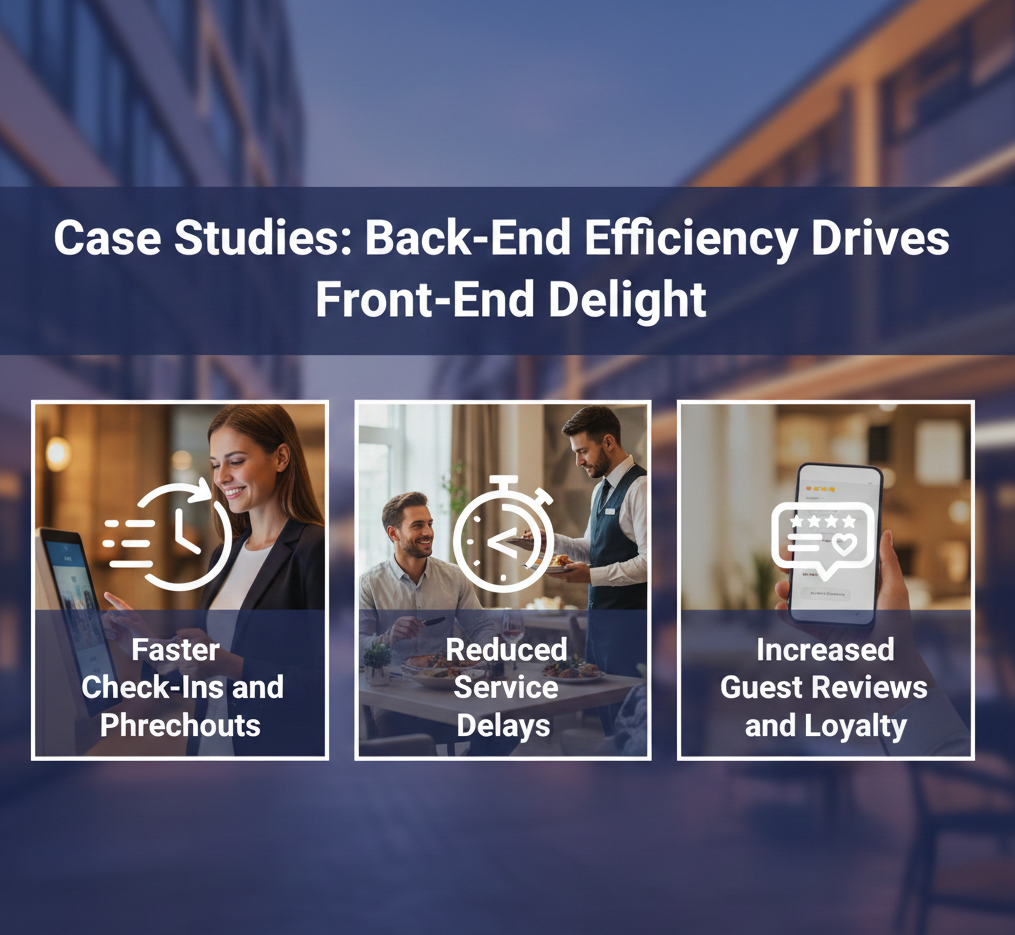
Case Studies: Back-End Efficiency Drives Front-End Delight
Technology may run in the background, but its results shine in the guest experience. Here are a few practical examples of how operational efficiency translates directly to front-end delight.
Faster Check-Ins and Checkouts
A guest's first and last impression often happens at the front desk. If rooms aren't ready at check-in or billing isn't synced at checkout, frustration rises fast.
By integrating Hotel Operations Software with PMS data, staff instantly know which rooms are ready, which need cleaning, and which are under maintenance.
This streamlined coordination reduces waiting time and improves overall guest flow, creating a smoother experience from arrival to departure.
Reduced Service Delays
In one mid-sized business hotel, the introduction of a Hotel Operations Platform reduced average guest service request times by 40%.
With real-time communication and automated task assignment, issues that once took 45 minutes were resolved in under 20. Guests noticed — and review scores reflected it.
Increased Guest Reviews and Loyalty
Guests rarely compliment software — but they always notice efficiency.
Hotels using integrated Hotel Operations Management Software report higher ratings on review platforms for cleanliness, service speed, and staff friendliness.
When everything behind the scenes works seamlessly, guests perceive it as exceptional service — leading to stronger loyalty and repeat bookings.
Steps to Enhance Operational Efficiency
Achieving operational excellence doesn't happen overnight, but small steps can lead to significant improvements.
Here's a roadmap for enhancing back-end efficiency while directly boosting guest satisfaction.
Implementing Smart Ops Tools
Start with Integration
- Connect your existing PMS with a Hotel Operations Companion Tool.
- Ensure that data — like check-in/checkout, maintenance, and housekeeping status — flows automatically.
Digitize Daily Workflows
- Replace paper-based or verbal communication with digital task assignments.
- Make sure every department has real-time visibility of task progress.
Train Teams for Adoption
- A system is only as good as the people using it. Provide short, role-based training sessions to build comfort and confidence.
Measure and Improve Continuously
- Use reports and analytics to identify inefficiencies.
- Celebrate quick wins to encourage team engagement.
Key Metrics to Track for Guest Satisfaction
- Average room readiness time after checkout
- Maintenance request resolution time
- Number of open tasks vs. completed tasks daily
- Guest request response time
- Employee performance scores
- Guest satisfaction and review ratings
Tracking these metrics through your Hotel Operations Management Software helps you identify trends and make informed improvements that directly enhance the guest experience.
Do's and Don'ts for Improving Operational Efficiency
Do's
- Integrate your PMS with an operations tool to eliminate data silos.
- Use automated alerts for critical tasks and preventive maintenance.
- Encourage staff accountability with transparent task tracking.
- Measure performance regularly using built-in analytics.
- Keep communication digital and centralized — one platform for all teams.
Don'ts
- Don't rely solely on verbal updates or WhatsApp groups.
- Don't treat technology as a replacement for people — it's a support system.
- Don't ignore training; digital transformation needs onboarding.
- Don't overlook small issues — minor inefficiencies add up quickly.
- Don't delay maintenance automation — prevention saves money and reputation.

Conclusion
Guest satisfaction doesn't begin at check-in — it starts with the invisible work happening behind the scenes.
When a hotel runs smoothly, guests feel it — not because they see your technology, but because they never experience the friction that comes from poor coordination, delays, or service gaps.
A Hotel Operations Software like InnCrew empowers every department — from housekeeping to maintenance — to work in harmony. By adopting a Hotel Operations Companion Tool that automates, tracks, and connects your operations, you create a foundation for efficiency that guests experience as exceptional service.
The future of hospitality isn't about adding more staff — it's about enabling your current team to perform at their best with the right technology. Efficiency behind the scenes is the quiet secret to unforgettable guest experiences.
Frequently Asked Questions
Q1: How is a Hotel Operations Companion Tool different from a PMS?
A PMS handles reservations, billing, and record-keeping, while a Hotel Operations Companion Tool focuses on daily operations like housekeeping, maintenance, and staff coordination. Both systems complement each other for end-to-end efficiency.
Q2: What size of hotels can benefit from Hotel Operations Software?
From boutique hotels to large chains, any property with multiple departments or floors can benefit. The larger the operation, the higher the impact of automation.
Q3: Does automation reduce staff involvement?
Not at all. Automation eliminates repetitive work so staff can focus on higher-value guest interactions. It enhances human service, not replaces it.
Q4: How quickly can hotels see results after implementing a Hotel Operations Platform?
Typically, hotels see measurable improvements — like faster room readiness and shorter maintenance response times — within 30–60 days of consistent usage.
Q5: Is it challenging to integrate InnCrew with existing PMS systems?
No. Modern Hotel Operations Management Software like InnCrew is designed to integrate smoothly with most PMS solutions, ensuring a seamless data flow between reservations and daily operations.