Hotel Housekeeping Checklist: Free Template for 2026
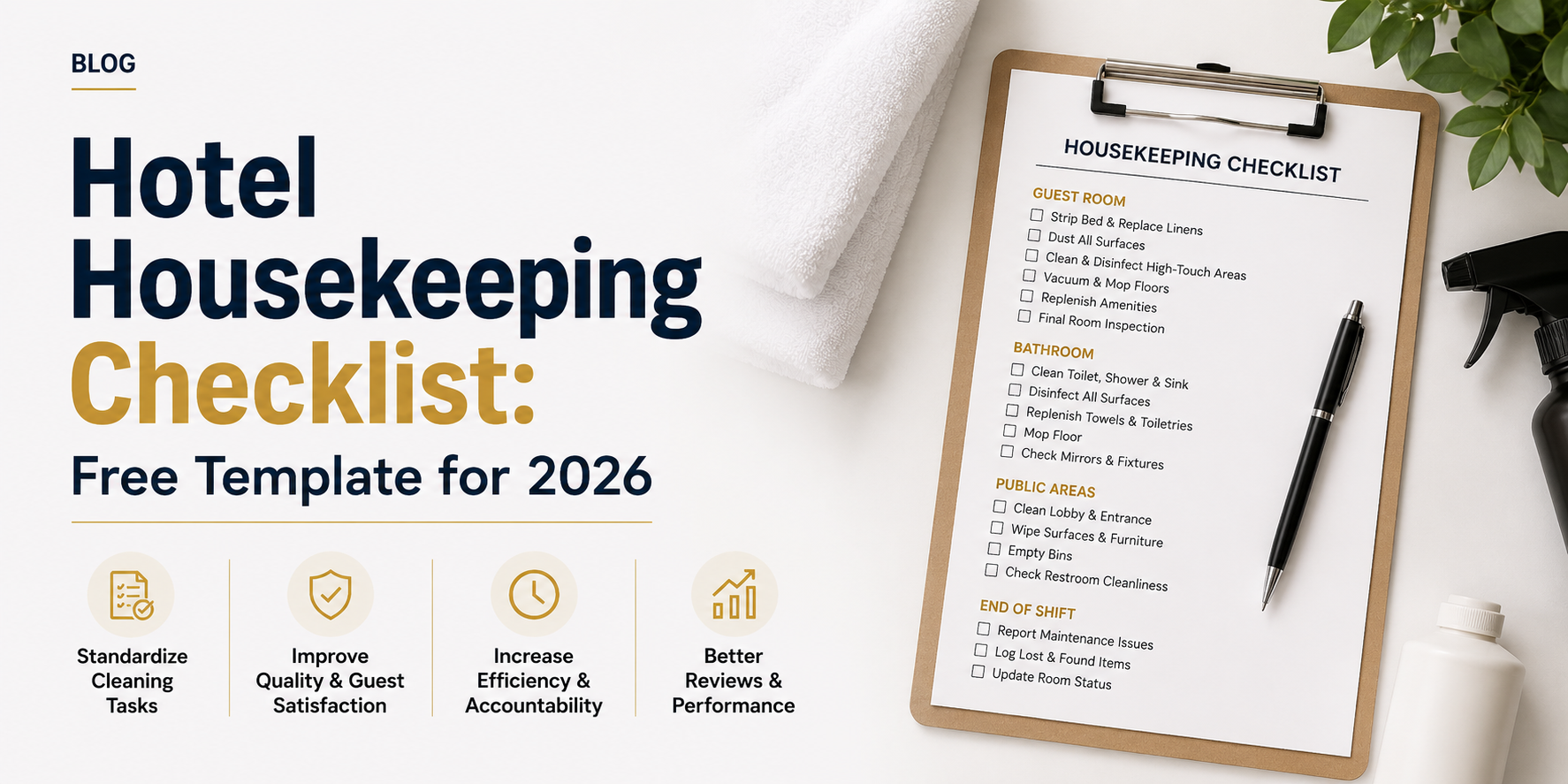
Ask any hotel general manager what the single most important operational process at their property is, and most will say the same thing: hotel room cleaning. Not because it is the most glamorous part of running a hotel, but because it is the one area where a failure is immediately, visibly, and painfully obvious to the guest sitting in the middle of it. A missed stain on the duvet. A bathroom that was not fully sanitised. A bin that was not emptied. These are the things that end up in reviews, and reviews affect bookings. What most hotel operators do not fully appreciate until they have dealt with the fallout is that these failures are rarely caused by a lack of effort on the part of housekeeping staff. They are almost always caused by a lack of structure, specifically, the absence of a clear, reliable hotel housekeeping checklist that every team member follows consistently, every single time.
This blog provides a comprehensive, practical checklist you can implement immediately, covering guest rooms, bathrooms, public areas, and shift management. We will also talk about why paper checklists have a ceiling and what the most efficiently run US hotels are using instead in 2026.
Why a Housekeeping Checklist Is Not Optional
Before we get into the actual checklist, let us spend a moment on why this matters beyond the obvious.
A hotel housekeeping checklist does three things that verbal instructions and experience alone simply cannot.
First, it standardises outcomes. When every housekeeper follows the same sequence of steps in the same order, every room meets the same standard — regardless of who cleaned it, what time of day it was cleaned, or how busy the shift was. Consistency is what turns a single good stay into repeat business.
Second, it makes people accountable. With documentation, one can track whether a task is completed. For example, when there is a list or checklist to follow, the manager can go through it and identify where the breakdown occurs rather than just noting that it has occurred.
Thirdly, it protects you from liability. If any hotel conducts itself in a way that causes its guests to complain about their health after staying there, the owners could face hefty fines. This is because there are no official records to show otherwise.
The Complete Hotel Housekeeping Checklist for 2026
On Arrival at the Room
Before any cleaning begins, the housekeeper must assess the room’s condition and properly prepare the workspace.
Knock and announce, even for confirmed checkouts; always knock and wait before entering. Note any items left behind by the previous guest and report them to the front desk before touching anything. Open curtains and all windows if ventilation is available. Turn on all lights to check for burnt-out bulbs. Do a quick visual sweep of the room to identify any damage that needs to be reported before cleaning begins.
Cleaning starts even before the actual process begins. It is an essential process that takes about 2 minutes and ensures the safety of not only the cleaner but also the guest’s property.
Guest Room - Full Cleaning Sequence
Strip and remove: Remove all used linens, sheets, pillowcases, and duvet covers and place them in the laundry bag. Remove all used towels from the bathroom and bedroom. Check under the bed and behind furniture for items left by the previous guest. Empty all bins and replace liners.
Dust and wipe all surfaces: Dust all horizontal surfaces in a consistent sequence, starting at the top of the room and working downward, so that any debris falls to the floor before vacuuming. This includes the tops of wardrobes and cupboards, headboards, bedside tables, the desk and chair, TV unit, windowsills, air conditioning vents, light fittings, and picture frames. Wipe all hard surfaces with the appropriate cleaning product. Pay specific attention to high-touch surfaces, remote controls, telephone handsets, light switches, door handles, and wardrobe handles using a disinfecting solution. Do not skip these. They are what guests notice and what hygiene audits inspect.
Make the beds: Apply a fresh fitted sheet, ensuring it is pulled tight with no creases. Apply a flat sheet or duvet with even overhang on both sides. Add pillows in fresh pillowcases, two per guest bed, as standard. Fold the duvet corner or apply a decorative fold per the property’s standard. Straighten the bedskirt if applicable.
Refresh amenities: Replenish all in-room amenities b, bottled water, coffee sachets, teabags, sugar, stir sticks, cups, glasses (washed or replaced). Check the minibar, if applicable, and restock; record any items consumed. Check that stationery, notepads, and pens are present and in good condition. Ensure the TV remote has working batteries.
Final room check: Vacuum the full floor, including under the bed and in the corners. Straighten all furniture back to its correct position. Check that all lights and appliances are functional. Check that the thermostat or air conditioning unit is set to the property’s standard temperature. Do a final visual check from the doorway — step back and look at the room as a guest would.
Bathroom - Full Cleaning Sequence
The bathroom is where guests form their strongest impressions about cleanliness. It deserves its own disciplined sequence.
Remove and clean: Remove all used towels and any used toiletries left behind. Flush the toilet and apply toilet cleaner inside the bowl — allow it to dwell while you clean the rest of the bathroom. Clean the inside of the shower or bath with an appropriate product, removing all soap scum, water marks, and any hair or residue from plug holes and drain covers. Rinse thoroughly. Clean the sink and tap fittings — paying close attention to the base of the tap where product and residue accumulate. Wipe down all tiled surfaces, the mirror, and any glass shower screens. Scrub the toilet bowl, then wipe the entire outside of the toilet — lid, seat, base, cistern, and flush handle — with disinfectant. Mop the floor.
Replenish: Place fresh towels — bath towel, hand towel, and face cloth — folded to the property’s standard. Replenish all toiletries — shampoo, conditioner, body wash, soap bar, lotion, shower cap, and dental kit if provided. Replace the toilet roll and ensure the spare roll is present. Replace the tissue box if it is low or empty. Ensure the bin is clean and has a fresh liner.
Bathroom final check: Run a finger along the tile grout line — this is what inspectors do, and it is what guests notice on close inspection. Check the mirror for streaks. Check the shower head is clean and free of limescale build-up. Confirm all surfaces are dry and streak-free.
Public Area Housekeeping - Daily Tasks
Guest rooms get most of the attention, but public areas are what guests see first. Their condition sets the expectation before a guest ever opens their room door.
Lobby and reception: Vacuum or mop the entrance floor and mat. Wipe down all reception desk surfaces. Clean glass entrance doors — removing fingerprints inside and out. Empty and clean public area bins. Dust all furniture, artwork, and decorative items. Ensure all seating is arranged correctly. Wipe down any accessible surfaces on check-in kiosks or guest service terminals.
Corridors and lifts: Vacuum corridor carpets; mop hard-floor corridors. Wipe all skirting boards and door frames. Clean lift doors — inside and outside panel buttons, door frames, and floor surface. Check all corridor lighting and report any failures.
Breakfast and dining areas: Wipe and reset all tables and chairs after each service. Clean condiment containers and replace if low. Mop or vacuum the floor after service. Clean and sanitise all food preparation contact surfaces.
End-of-Shift Checklist
The end of shift is where many operational failures originate — not because of what was done wrong during the shift, but because of what was not communicated properly between shifts.
At the end of every housekeeping shift, the team member should complete and hand over the following:
Confirm which rooms have been cleaned and signed off. Report any rooms that were not completed, along with the reason. Log any maintenance issues identified during cleaning — broken fixtures, damaged furniture, plumbing issues — with room number and description. Report any lost property found during the shift. Confirm that all cleaning supplies used during the shift have been logged and that low stock levels have been reported. Return the master key card to the designated secure location.
Why Paper Checklists Have a Real Ceiling
This checklist does work. When all members of your housekeeping staff use this list consistently, you’ll see improvements in the quality of your rooms, as well as reductions in the number of your inspection failures.
But paper checklists have a fundamental limitation that becomes more apparent as your property grows and becomes busier. They cannot update in real time. When a room becomes a priority due to an early check-in two hours into the shift, a paper list doesn’t know about it. When a housekeeper completes a room, that completion is not visible to the front desk until someone physically notifies the front desk. When a maintenance issue is logged on a paper form, that form has to physically travel from the housekeeper to the supervisor to the maintenance technician—a process that takes time and can get lost in busy shifts.
This is where hotel housekeeping management software completely changes the operational picture. When your housekeeping checklist lives on a mobile device rather than a printed sheet, updates are applied to the entire team in real time. The front desk knows a room is ready the moment it is marked complete on a housekeeper’s phone — not after three radio calls. Priority reassignments push to every housekeeper’s device instantly. Maintenance issues are logged directly into the work order system the moment they are spotted.
For independent hotels in the United States with smaller staffs, mobile housekeeping technology should not be considered an enhancement to their system but rather a necessity for creating high-quality housekeeping practices without additional supervisors.
What Digital Housekeeping Management Looks Like in Practice
The housekeeper who has been given hotel employee room assignment software to use on their phone will begin their shift by seeing all the rooms assigned to them, sorted by the order of check-in rather than a fixed room order. After completing each room, the housekeeper marks it in the app, and the change is reflected in real time across the entire network.
For the supervisor, hotel operations software provides a live dashboard showing every room in the property — clean, in progress, inspected, or in maintenance hold — at a glance, from anywhere in the building. For the general manager, the same level of visibility is available from any device, so operational oversight does not require physical presence.
For the maintenance team, any issue logged by a housekeeper during their clean arrives as a digital work order — already assigned, already timestamped, already tracked through to resolution.
This is the operational difference between a hotel that runs consistently and one that runs on luck and verbal communication. Hotel staff management software connects every part of the team in real time, turning the housekeeping checklist into a live, dynamic process rather than a static document printed at 7 am and obsolete by 8 am.
The Bottom Line
A well-structured hotel housekeeping checklist is one of the highest-return operational tools any hotel can implement. It standardises quality, creates accountability, reduces guest complaints, and protects the property from liability. For 2026, the most effective version of that checklist is a digital one — living in a mobile app that connects your housekeeping team, your front desk, and your maintenance team in real time.
Whether you start with the paper checklist in this blog or move immediately to a digital solution, the important thing is that you start. Consistent process beats talented improvisation every time in hotel housekeeping — and the proof shows up in your review scores within weeks of implementation.
FAQ
Q1. What should be on a hotel housekeeping checklist?
A hotel housekeeping checklist should include room cleaning, bathroom sanitization, linen replacement, amenity replenishment, floor cleaning, and a final room inspection.
Q2. How do hotels manage housekeeping efficiently?
Hotels use checklists, task assignments, and housekeeping software to track room status and improve team coordination.
Q3. How often should hotel rooms be cleaned?
Rooms should be cleaned after every checkout and refreshed daily for stayover guests, depending on hotel policy.
Q4. What is hotel housekeeping management software?
It is a digital tool that helps housekeeping teams manage room assignments, track cleaning status, and report issues in real time.
Q5. How do you create a hotel housekeeping checklist?
List all cleaning tasks, arrange them in a logical order, test the process, and update the checklist as needed.
Q6. What is the difference between a stayover clean and a checkout clean?
A stayover clean refreshes an occupied room, while a checkout clean fully prepares the room for the next guest.
Q7. How can hotel software improve housekeeping performance?
It speeds up task assignments, improves room tracking, reduces missed tasks, and helps teams work more efficiently.
Q8. How many rooms can one housekeeper clean per shift?
Most hotel housekeepers clean around 12–17 checkout rooms per 8-hour shift, depending on room size and cleaning standards.